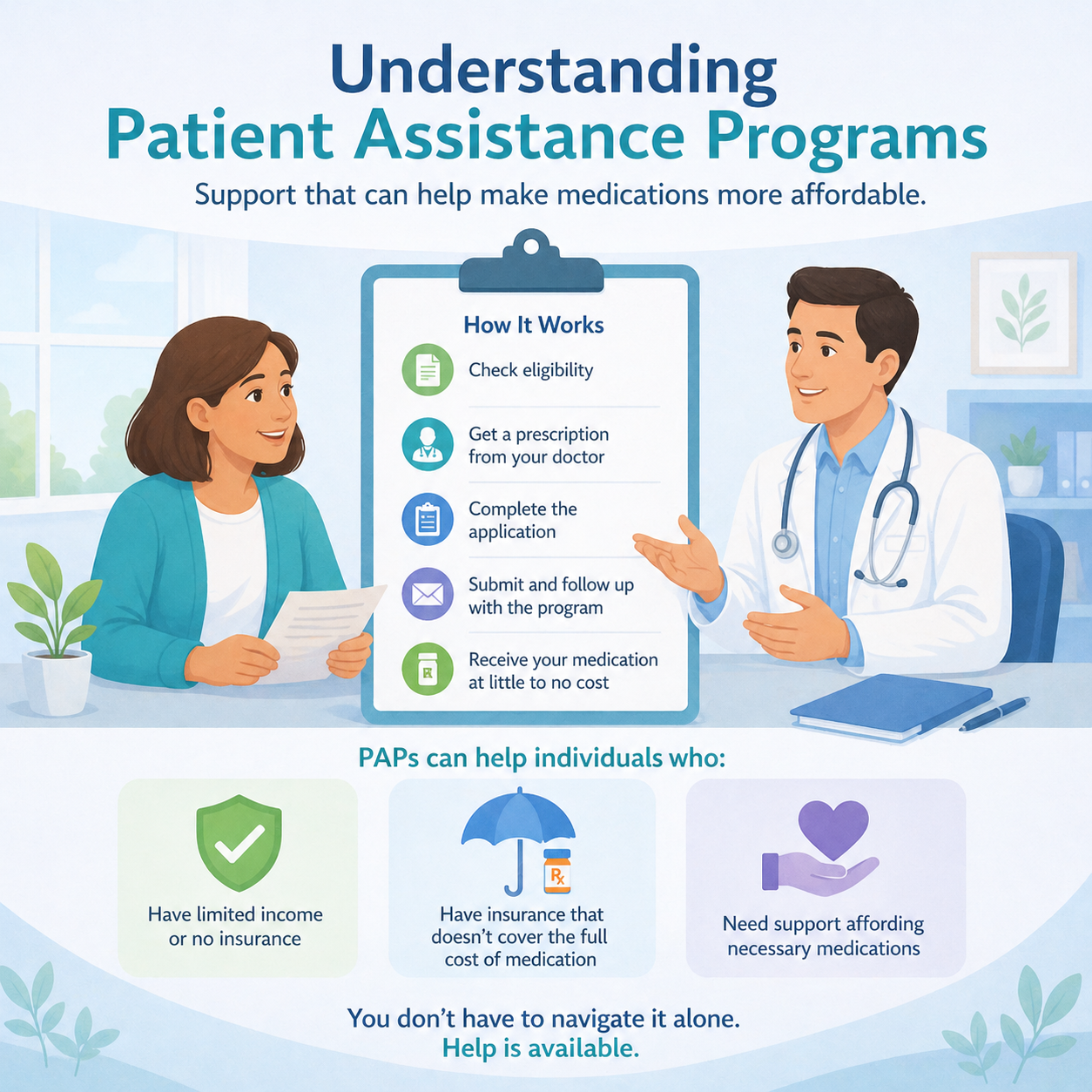
Last updated: August 10, 2026
- A $500 monthly prescription can shrink fast — sometimes to $50, sometimes to nothing.
- If a drug costs $500 a month and a PAP lowers your share to $50, that is a real change.
- How to Apply Without Getting Stuck Usually, the application is manageable if you get organized first.
- How long will the medicine be needed?
A $500 monthly prescription can shrink fast — sometimes to $50, sometimes to nothing. Patient assistance programs, or PAPs, help people who meet the rules cut drug costs, and the trade-off is plain: you have to qualify, then do a bit of paperwork. Some programs hand over medicine at no cost. Others trim a copay or cover a short-term supply. The rules change by drug. Always.
Quick Answer
Too much for a prescription? Check whether the drug has a PAP before you do anything else. Many of these programs come from drug makers, and eligibility often turns on income, insurance status, and where you live. A small stack of forms can bring big savings; in some cases, that means a very low cost for a covered medication, depending on the program and plan rules.
What Patient Assistance Programs Do
PAPs help patients get medicines they might not be able to afford. They often come from pharmaceutical companies. Some serve people without insurance. Others are aimed at patients whose plan does a poor job covering a specific drug.
Lower cost is the whole point. And that matters fast when a brand-name medication runs hundreds of dollars every month. It also matters for treatment that goes on and on, but you should confirm the details with the program, a pharmacist, or your care team. Twelve monthly bills hit differently than one. Brutal, really.
PAPs are not the same as a coupon card or a discount website. They usually ask for a formal application. Many also require income documents, a prescription, and a doctor’s signature.
Who Usually Qualifies
Eligibility is not identical from one program to the next. Some PAPs accept only U.S. residents. Others are limited to people with low income. A few rule out patients who already have strong prescription coverage. Others still help if the plan does not cover the drug or if the copay is too high.
That is why the fine print matters. One medicine’s program may be generous; another can be much tighter. Read the rules for the exact drug you need, then confirm them with the program or your care team.
How to Apply Without Getting Stuck
Usually, the application is manageable if you get organized first.
- Find the medication name and the company that makes it.
- Check the program rules for income, insurance, and residency.
- Gather proof of income, proof of address, and your insurance card if you have one.
- Ask your doctor’s office to help with the prescription section.
- Submit the form and keep a copy of everything you send.
A missing signature can stall things. So can an old tax form or a wrong address. Online forms may save time if the program accepts them. Paper only? Mail tracking helps.
Where PAPs Help Most
PAPs tend to help most with expensive brand-name medicines and with chronic conditions that need long-term treatment. If a drug costs $500 a month and a PAP lowers your share to $50, that is a real change. If the medicine is free, the savings are even larger.
They can also bridge a short gap. For example, if a patient is waiting for new insurance or a benefit appeal, a PAP may cover the gap. But check the timing with a pharmacist or benefits counselor before you count on it, because some programs take days and others take longer. Timing can go sideways in a hurry.
Honest Trade-Offs
PAPs help, but they are not easy money.
- The rules can be strict.
- The paperwork can take time.
- Some drugs are not covered.
- Approval depends on the program and your eligibility.
And there are cases where a PAP may not be worth the effort. Need a medicine for only a few days? The application may take longer than the benefit. If a generic version costs less than your time and paperwork, that may be the better choice. If your insurance already makes the drug affordable, a PAP may not add much value.
A Simple Way to Compare Your Options
When you are choosing between PAPs, insurance, or paying out of pocket, ask three questions:
- What will I pay this month?
- How long will the medicine be needed?
- How much work is required to get the discount?
A PAP may offer the lowest drug cost, but it can have a higher effort cost. Insurance may be easier to use, but it is not always the cheapest option. Paying out of pocket is fastest — though usually the most expensive choice.
Alternatives and Risks
For some prescriptions, a generic drug, a manufacturer coupon, or a pharmacy discount card may fit better than a PAP. If the medicine is only needed briefly, those options can be quicker. If it is needed for months, a PAP may save more.
Mistakes can slow or stop an application. A missing signature, expired income document, or wrong drug name can cause delays. For prescription, insurance, or income questions that affect your care, a pharmacist, doctor, or benefits counselor can help you sort through the options.
Bottom Line
Patient assistance programs can save real money, especially if you take a costly medicine and qualify for help. The best time to check is before you skip a refill or rack up debt. Start with the drug maker, read the program rules carefully, and ask your doctor’s office to help with the form.
For prescription, insurance, or income questions that affect your care, a pharmacist, doctor, or benefits counselor can help you sort through the options.