Last updated: August 10, 2026
- A lower monthly copay can matter more over 12 months than a small difference in appearance or packaging.
- The FDA has reported that generics make up about 9 in 10 prescriptions, even though they account for a much smaller share of total drug spending.
- Key Facts Brand-name drugs are sold first, while generic versions usually enter after patent protection ends.
- The FDA says generic drugs are reviewed to make sure they match the brand version in key ways.
Trying to cut prescription costs without changing treatment? Brand name vs. generic medications: comparison is usually the first question worth asking. Generic drugs use the same active ingredient as the brand-name version, and the FDA says they must work the same way in the body within set limits.
Quick Answer
In the U.S., most prescriptions are filled with generics. The FDA has reported that generics make up about 9 in 10 prescriptions, even though they account for a much smaller share of total drug spending. This gap is why they show up so often in long-term care and chronic disease treatment; still, a clinician or pharmacist should review the choice for specific medicines.
Key Facts
- Brand-name drugs are sold first, while generic versions usually enter after patent protection ends.
- Generics must meet FDA standards for strength, quality, purity, and how the drug is used in the body.
- The FDA says generic drugs are reviewed to make sure they match the brand version in key ways.
- Generic prices are often much lower, but the exact savings depend on the drug, pharmacy, and insurance plan.
- A doctor or pharmacist should review the switch if you take a drug with a narrow safety range, such as some seizure or thyroid medicines.
What Is the Real Difference?
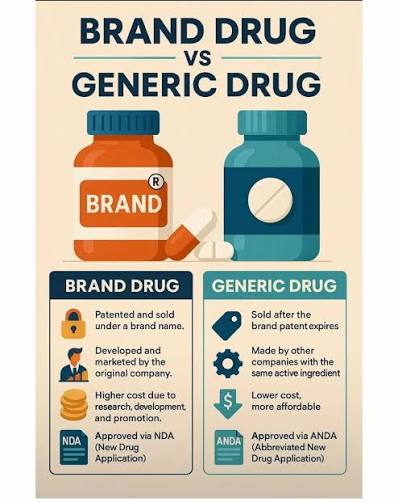
Brand-name medicines are developed, tested, and marketed by the original company. During that early work, costs are high, and patents let the company sell the drug alone for a period of time.
A generic version uses the same active ingredient. It can differ in shape, color, flavor, or filler ingredients. Those changes do not alter the main effect, but they can matter for some patients. Small stuff, big feelings.
Price is the biggest practical difference. Because the maker did not pay the original research and launch costs, many generics cost less. A 2022 FDA consumer update said generics can save patients money and may help them stay on treatment, though patients should still confirm any switch with a pharmacist or prescriber. See the FDA’s consumer update and FDA generic drugs overview for details.
When Brand Name May Be the Better Choice
Sometimes a brand-name drug fits better because the formulation matters. This can happen if a patient is sensitive to dyes, binders, or other inactive ingredients.
Brand-name treatment can also make sense when a doctor wants a very specific delivery form. For example, extended-release tablets and inhalers can feel different even when the active drug is similar, so a clinician or pharmacist should review the option.
Trust matters too. If a patient has taken one version for years and is stable, a switch may cause worry or confusion, even when the medicine is medically acceptable.
When Generic Medications Make Sense
When cost is the main barrier, generic drugs are often the practical pick. Should a patient skip doses because the brand version is too expensive, the generic may be the better treatment simply because it is more likely to be taken as prescribed, but a prescriber should confirm the switch.
They are also a common choice for long-term medicines. A lower monthly copay can matter more over 12 months than a small difference in appearance or packaging.
“Cheaper” does not mean “best for everyone.” Fair point. A generic is useful when it fits the prescription, the patient, and the insurance plan.
Mistakes and Risks to Watch For
Medication mix-ups can happen during a switch. One common mistake is assuming every pill with the same effect looks the same. It does not. Shape and color can change by manufacturer.
Another risk is taking both versions at once by accident. This can happen when a pharmacy changes suppliers and the label looks different. Checking the active ingredient on the bottle can help, but it is best to confirm with the pharmacist if anything looks unfamiliar.
A second risk is assuming all generics are interchangeable without review. That is not always wise for drugs where small dose changes matter. If your medicine has a narrow therapeutic window, ask a pharmacist before changing products. That line can save a headache later.
Honest Side-by-Side
| Criteria | Brand Name | Generic |
|---|---|---|
| Active ingredient | Original product | Same active ingredient |
| FDA review | Approved for safety and effectiveness | Reviewed for bioequivalence and quality |
| Price | Usually higher | Usually lower |
| Appearance | More consistent | Can vary by maker |
| Inactive ingredients | Can differ | Can differ |
| Best use | When a specific formulation is needed | When cost and access matter most |
How to Choose Between Brand Name vs. Generic Medications
When to Rethink the Choice
Sometimes the real issue is not brand versus generic. It may be the dose, the form, or the drug itself. If side effects start after a switch, if the medicine does not seem to work the same, or if you are paying too much for either version, ask your prescriber or pharmacist to review the full plan.
Bottom Line
Brand-name and generic medications are both legitimate options, and both can be effective. The best choice depends on the drug, the patient, and the cost. For many people, a generic is the practical first pick. For some, a brand-name product is worth the extra cost because of ingredient sensitivity, device design, or prior stability.